Showing posts with label Economics. Show all posts

Wednesday, May 4, 2011

How high should the wage hike be?


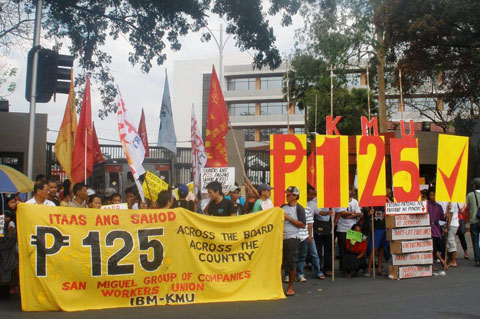
Political organization, or more precisely, mob intimidation, cannot change the laws of economics but only make it harder for employers to keep their business running. Raising wages will in the long run reduce job opportunities and increase the price of consumer goods. The poor stand more to lose since they are on fixed income and spend a large portion of it on consumer goods. Notice also that it is always the employers who are at fault while the government itself, which is the source of the problem, is never questioned


I have already argued in a previous article that wages are primarily determined by productivity and not by the discretion of the employer. Generosity or good faith of the employer has very little to do with it. If the laborers get wages which are higher than what all of them can produce, then the employer will either have to pass the additional labor costs to the consumer in the form of higher prices or file bankruptcy.

The minimum wage laws also have glaring contradictions. The labor code allows for exceptions. Physically and mentally impaired individuals as well as apprentices and learners can be paid at least 75% of the minimum wage. Firms employing less than ten workers are exempt from paying minimum wages. If you ask why certain exceptions are made, the answer will be based on economics. But then that only defeats the purpose of the minimum wage law in seeking to reverse the laws of economics. If we must defer to economics in the case of the physically disabled workers, why not defer to economics when it comes to workers in general? After all, economics applies at all times and in all places.

Arguments against minimum wage laws are not only theoretical, as prices of consumer goods increase every time a wage hike is ordered by the Philippine government.

Some don't buy into the argument that businesses would close if minimum wage rates were increased. They charge hypocrisy on business owners who take their families on expensive vacations while not giving workers enough to eat. This is of course an exaggerated claim. If a worker's wage is not enough for him to eat, then why is he still working in that same job in the first place? It is ridiculous to claim that workers don't have enough to eat when a lot of them already support many children with that meager wage, but that is a topic for another discussion. Just because an employer is rich doesn't mean he must pay wages at more than the worker's productivity level. The employer could have gotten the vacation money from saved profits in the past. Why should the employer use those saved profits to subsidize a business which is made unprofitable by the minimum wage? Why should the employer enter into an employment agreement where he has nothing to gain? It really redounds to an advocacy of the Marxist exploitation theory, whether or not people are aware of it. Pro-labor advocates think that profits are undeserved because it is taken from labor's 'full value'. Fortunately, Marxist fallacies have been refuted by economists of Marx's own generation.

To those who think labor has a right to a share in profits, I quote from capitalism.org

"Why are the laborers who demand a share in the capitalist's profits, silent in demanding their "share" when he incurs losses? Why don't they cry out and demand that they get to receive a share in those losses? If labor is the sole cause of all profit, then is it not also the sole cause of all losses? A moments reflection will point out that laborers are only responsible for their job description -- they are not directly responsible for the losses of a business -- and that the cause of an enterprise's losses lies essentially with the owner, as do the profits."


Then there's the bargaining power argument. There are more workers than work, they say, and the workers have to accept lower than productivity wages because the employer can just hire somebody equally desperate for a job. The premise of this claim is palpably false as it does not recognize the primordial fact of scarcity, which is the whole basis for the study of economics. There is always going to be jobs available because humans have unlimited desires and limited means to meet those desires. Bargaining power is actually dependent on productivity. The greater the gap between a worker's productivity level and his wage, the greater the risk that that worker will be hired by a firm offering a higher wage. Competition among employers bids up the price of labor to the point where it approximates productivity levels. If one disdains the difference in 'bargaining power' between employers and employees, then one must place the blame on anti-competitive government interventions such as permits, regulations and anti-trust laws.

The laws of economics cannot be changed by passing legislation. The only way to deal with the primordial fact of scarcity is through entrepreneurial discovery of more efficient ways of allocating resources. This means allowing the price mechanism to work and the profit and loss system that follows it. In hard times such as these, we need markets more than ever.

Sunday, May 1, 2011

A Striking Observation of Socialist Health Systems


Actress Natasha Richardson died in 2009 because she could not be treated for head injury in Canada, she is an unfortunate victim of socialist health care


I have argued before that US health care ‘insurance’ is not really health insurance because it covers uninsurable health conditions. In my past article I said,

"There can only be insurance where insurance companies can create groupings and sub-groupings of classes. In order to do this, they have to --- wait for it --- discriminate! Suppose insurance company X has a number of professional boxers and economists as clients. They would of course have to segregate the two groups. The professional boxer has to pay a higher insurance premium because his risk of injury is much higher than that of the economist, more importantly, he has to be pooled together with other boxers while the economist has to be pooled together with other economists. Putting the two groups in one pool will amount to a redistribution scheme as the economist has to pay a higher premium, subsidizing the boxers he is being pooled with."

"[Situations which are] under the control of individuals are not insurable. There is really no such thing as car insurance since the physical condition of a car falls under the responsibility of its owner. No insurance company would offer car insurance since they will incur losses because of clients taking advantage of car insurance. This rule is also the reason why so -called government 'unemployment insurance' creates more unemployment. The government has created, in the realm of health care, a scheme similar to having insurance on the loss of sales of a business ---- it is that ludicrous!"

"It is obvious that health care insurance in the United States even before Obamacare is really just a fraudulent redistribution scheme creating perverse incentives that will make a population less healthy and more degenerate. It is therefore no surprise why so many Americans do not have health insurance for the simple reason that they did not want to pay high premiums to subsidize sickness, recklessness and degeneracy and in the process creating more of such."


Ludwig von Mises stated that,

"The psychic forces which are active in every living thing, including man, in the form of a will to health and a desire to work, are not independent of social surroundings. Certain circumstances strengthen them; others weaken them. The social environment of an African tribe living by hunting is decidedly calculated to stimulate these forces. The same is true of the quite different environment of the citizens of a capitalist society, based on division of labor and on private property. On the other hand, a social order weakens these forces when it promises that if the individual's work is hindered by illness or the effects of a trauma, he shall live without work or with little work and suffer no very noticeable reduction in his income. Matters are not so simple as they appear to the naive pathology of the army or prison doctor."

"Social insurance has thus made the neurosis of the insured a dangerous public disease. Should the institution be extended and developed, the disease will spread. No reform can be of any assistance. We cannot weaken or destroy the will to health without producing illness."


Many free marketers argue that data affecting mortality rates cannot be used when comparing the US health care system (which is semi-socialized since the State comprises 50% of health care spending) with UK/Canadian health care systems because Americans kill each other more often, consume more narcotic drugs and have unhealthy lifestyles leading to obesity and illnesses. However, those unhealthy lifestyles and crime statistics are also caused largely by government and not by some wild American ‘culture’. The unhealthy lifestyle is subsidized by the welfare scheme as explained above while the high crime rates and narcotic drug usage can be explained by the destructive ‘War on Drugs’.

It is interesting because the US system encourages sickness while the UK/Canadian system discourages it. The UK/Canadian health care systems discourage getting sick because getting treatment is such a hassle and quality is low. Waiting lines don’t really coincide with consumer preferences while sin taxes and FDA regulations do not give citizens of social democratic Europe many options to live unhealthily. This is the reason Americans are obese while Europeans are fairly fit (not to downplay the thousands who die every year in the socialist hospitals of the UK and Canada, see here, here, here and here). In the end though, no one is happy and human freedom is lost when responsibility and control over health and life are surrendered to politicians.

Monday, April 4, 2011

Fruits of State Resource Management: The Case of Pasig River, Manila Bay and Makati Area Slums

Public property can be seen as one type of interventionism. The most pollution happens in public land because government does not have an incentive to take care of its property. As a result, those on the perimeters of the public land are affected. People living on the side of roads, seas, and rivers suffer from the pollution that is encouraged. Just look at Pasig River. Huge amounts of money and effort were expended to pressure the government to 'do something' about the dying river. And even now the its pH level is just enough for fish to survive. We would likely see little or no outcry if that river was privately owned. The owner would make use of it in the most profitable way he can think of, which means that resource will be used in the most socially optimal way. Even if the government successfully cleans Pasig River, it would still remain an idle resource slowly accumulating pollutants again.


Pollution is encouraged when the resource has no owner, i.e. public property.

Recently, there has been news of a residential community urging the government to cleanup the shores of Manila bay. As a result, 130,000 squatter families will be displaced without relocation. Here we see another effect of public property, the creation of conflict between different groups of people. The poor cannot find work because of the minimum wage and are made dependent on government urban planning schemes. They end up in public land that are then leased to those who have political pull. If private property were respected, then the homesteaders (the first to imprint his mark as owner) of the shores of Manila Bay would become the rightful owners. The squatters who now stay there would not have been made dependent and treated as expendable by politicians but would have found employment at a wage matching their level of productivity.


Public property not only encourages pollution, but creates conflict between different groups of people. The government relocates slum dwellers to areas which are polluted due to its own mismanagement. Now their homes are going to be demolished because of the whims of those with political pull.

In a free market, poor urban areas would be bristling with commerce because of employment opportunities provided by capitalists. Wages would be bid-up through competition between different capitalist employers vying for labor power. The relationship between rich and poor would be mutually beneficial, give-and-take, value for value. It now be very different from the situation now where wage controls restrict employment opportunities and the location of the urban poor is arbitrarily determined by government zoning. If the minimum wage, urban planning and welfare schemes were abolished, the poor would either find employment in the city or move to areas where the cost of living is low or in the peripheries of the city. Government urban planning creates disorder, leading many to wonder why there are slums not so far away from large banks and 5-star hotels like in Makati. It gives the impression of an inherent conflict of interest between the rich and the poor, with the former gaining at the expense of the latter. How is it that there can be cooperation across long distances, as in the case of foreign capital investment putting upward pressure on wages in China, but not amongst individuals a few kilometers away? This is the destructive power unintended consequences of interventionism. It makes enemies out of neighbors by outlawing mutually beneficial employment through the minimum wage on the one hand, and promoting dependency through welfare on the other. This economic and social inequality is then exploited by the Left to promote Marxist class struggle theory which only make the problem worse. The last thing slum dwellers need is a false ideology.


Most of the slum dwellers are unemployed or work in undeveloped extra-legal economies. Why aren't the rich in Makati 'exploiting' the nearby slum dwellers by making them work for low, but higher than pre-existing, wages? The answer: The government makes it illegal for them to do so.


Under conditions of capitalist freedom, the shores of Manila Bay would be de-socialized ( 'privatization' is misleading) and the residential community living nearby would own shares to it. The squatters, since they are also victimized by government intervention, could also be given shares, albeit less since they are 'late-comers'. The government would not be paid anything. Voluntary arbitration (not political pull) would settle the matter with equal representation of the two groups and conflict easily relieved. Private property is the best means man has discovered to solve conflicts. A society, for it to be considered civilized, must recognize it.

To contrast, 130,000 families are going to be driven to the streets just so to waste tax-payers money on cleaning up the shores of Manila Bay, unproductive land which will eventually accumulate pollution in the future. Not only is this insensitive, it is un-capitalist and uncivilized.

Sunday, April 3, 2011

Should the Government Regulate the Financial Markets?

A summary of a debate between Walter Block and Richard Squire. The video can be found here


The modern banking system is based on fractional reserves which is government sanctioned fraud. It is therefore anti-capitalist.


Richard Squire:


1. Creditors of banks are not as vigilant as creditors of other agencies so a bank-run on one bank means a bank run on all banks.

2. Private credit rating agencies do not have the incentives.

3. Insider trading: Block argues that insider trading is arbitrary, no real victim, unenforceable, and stops information from being reflected in prices. But regardless, inside traders will create volatility in the market to make money.

4. Block will argue that corporations could ban insider trading in their charters. But there is no empirical support for this.


Walter Block:


1. Government is immoral because it forces people to pay taxes and it won’t allow you to secede. If it won’t allow you to secede then you’re a slave. Government is inefficient because it can’t go bankrupt. FEMA wouldn’t allow any help to come in. They killed 1500 people. Are they still in business? Yes. So we shouldn’t have a government at all because its immoral and inefficient. If the government shouldn’t exist at all then they shouldn’t intervene in anything.

2. Financial markets are too important for the government to intervene in them. If we really should have government intervention, let it be in the production of paper clips and rubber bands. One half of every trade is money so financial industry is very important. The Fed is a Soviet central planning board. A gold standard would mitigate volatility. The reason we have bank runs is fractional reserve banking. Fiat money, legal tender and FDIC are all bad.

3. Yes, FDIC prevents bank runs by creating money galore but this will cause hyperinflation.

4. There is no market failure if there is no market to begin with. So the solution is to remove the government intervention that created the problem in the first place.

5. If the fact that ordinary individuals are not sophisticated enough to regulate banks themselves is the reason we should have government intervention in the financial markets then we should have government intervention in all areas of the economy as well since we are not sophisticated in most things which are not related to our hobby or occupation.

6. The volatility of the stock market before and after the inception of the Fed is very different. The Fed causes the instability.

7. ABCT – Fed misallocates resources by lowering interest rates. The debate is monetary or fiscal intervention. Fiscal Keynesianism versus monetary Keynesianism.

8. Insider Trading: Michael Milkin: He is the private solution to market volatility. The CEO high salaries were possible by giving lower dividends to shareholders so the stock price plummeted. Michael bought shares and kicked out the CEOs. But the government put him in jail.

9. Market rating agencies: Government influenced the credit rating agencies.


Richard Squire:


1. ‘Road to Serfdom’ theory is not empirically founded. Europe has a lot of political freedom even while being increasingly interventionist.

2. Empirical evidence trumps your reduction ad absurdum.

3. Fractional Reserve Banking existed before fiat money. It is the government that limits FRB by requiring minimum reserves. FRB is what private banks naturally want to do.

4. Takeover artists like Milkin are going to be banned by corporate charters.

5. There are a lot of takeover artists who were not jailed.


Walter Block:

1. Reduction ad absurdum is good because it challenges the premises.

2. He called me an ideologue but aren’t we all ideologues since we study ideas.

3. The government looks good when you only look at one-half institution. Anything that the government does cannot be justified because its based on coercion.

4. If you jail one takeover artist then that sends a signal to other takeover artists.

5. FRB implies bank run because its instantaneous debts are greater than its instantaneous assets. It’s only got 100 bucks and has a 190 outstanding so it ought to be allowed to be bankrupt but the government is protecting it.


Q&A:

Why haven’t we had free market anarchism if it’s so good?


Block: Countries with more economic freedom are richer. Libertarians are a small minority because humans are not hardwired for implicit cooperation. We do not fear bathtubs but we fear snakes even if bathtubs have killed more people than snakes. This is an example of sociobiology. Another example is that people who stood in line wanting to benefit from price gouging during Katrina cheered when the police arrested the price gouger.

The winner of this debate is....

Subsidy through mandatory oil price discounts will not work


Anybody with knowledge of economics101 knows that price controls create shortages by pushing the price below the point where supply and demand meet. Price controls also discourage production by reducing profit margins, even wiping them out. Marginal producers are likely to go out of business because of lower profit margins than well established firms. So when it comes to the oil industry, one can't cry oligopoly whilst supporting price controls.

Subsidization of an interest group, such as drivers of Public Utility Vehicles (PUVs), by forcing gas stations to give discounts also has the effect of disrupting the price mechanism. But in this case the market still has the opportunity to prevent shortages by charging higher prices to consumers not given a discount. There is no such thing as a free lunch. Government intervention to subsidize one interest group, PUV drivers, can only be possible at the expense of those not included in that interest group, everybody else who buys gas.

Some would argue that mandatory discounts are only fair. After all, PUV drivers are at the lower rung of the income bracket. Moreover, most individuals who use PUVs to travel are also part of the lower income bracket. Mandatory discounts at the gas station would remove the need to raise transportation fares, and in effect subsidize consumers.

But if poverty justified economic subsidization then we would also need to pass legislation to give the poor discounts in buying food, medicine, clothes, etc. But we do not give mandatory discounts to the poor even in these basic necessities. Even scholarships and other financial subsidies in universities are not given solely on the basis of poverty, but on academic merit. And there is a lesson to be learned here. In a free society, poverty is only a stage in life. Each person is born under unique circumstances and some may be considered more permanent than others, but individuals are largely placed in their 'proper' role in society by the time they reach middle age. By then, poor people are poor because of only three reasons:

1. Incompetence, laziness, antisocial behavior resulting in low productivity
2. Contentment with current financial condition
3. Injustice caused by government (e.g. minimum wage, taxes, inflation)


If poor who fall into category 1 are subsidized, then the ills associated with them will also be subsidized and society will have more incompetence, laziness and antisocial behavior. If the poor who fall into category two are subsidized, then this will amount to minding of other peoples' lives and presuming to know what's best. The poor who fall into category 3 should be helped by repealing legislation such as the minimum wage. It is clear that government intervention should not be used in all three counts. The simple fact is, if the poor had the same material standard of living as the rich, then no one would want to be rich. In other words, no one would have the incentive to work hard and produce for his fellow man. Both theory and history teach us that the result of egalitarianism is a Soviet economy where the only incentive to work is fear of death and torture. (Socialism cannot 'work' w/o killing fields, this is something the Leninists knew that the social democrats still haven't learned)

Let's go back to the main issue of mandatory gas price discounts for PUV drivers/operators. Some would still support such legislation not because PUV drivers are poor, but because their fuel cost increase makes them the most affected among the poor. But this is only because of standardized transportation fares. Without government standardization, drivers would be able to raise transportation fares to a level where profit margins are not much reduced (if not for increase in gas prices). Freedom of individual PUV drivers to set fares would remove their being a 'special' case among the poor and make mandatory gas price discounts unjustified.


Non-subsidization of PUV drivers and removal of standardized fares will prevent further problems but it will not solve the main problem of higher gas prices. The solution lies in economic freedom. Cut taxes, remove regulations, lower tariffs, abolish licensing. That's only the tip of the iceberg. More ambitious would be to stop the war in the Middle East, outlaw fractional reserve banking, and de-socialize public land for purposes of oil drilling. Lower prices can only come about via increased supply and stable currency. All the aforementioned government interventions discourage production either directly or indirectly and hence should be abolished. Freedom is always the solution, always.

There are of course some people who's ideas, if followed, assure not only increased costs but destruction of the social order itself.

Friday, January 7, 2011

Prices, Fares, Toll Fees and Statism


The Central Lesson Here: Government is Bad

Food prices – Government prevents the supply of food from abroad by its imposition of tariffs on commodities such as rice, wheat and sugar. The logic of the state is that without the high prices created by the imposition of tariffs, local producers would go unemployed. Yet Noynoy Aquino is going to sign an executive order removing the tariff on wheat in order to reduce flour prices by P20.00 per bag. It seems that the government is very arbitrary as to its trade policies, not wanting to put too much of a shock on the consuming public.

The uncertainty created by land reform affect the prices of food as landowners become hesitant to invest funds to make their operations more efficient. Land reform thrusts the peasant farmer into an entrepreneurial position where he may not be suited for. There are many reports of the distributed land being sold back to the landowner because of bad debt-management and necessary technical know-how. The point is that land reform lowers output and contributes to high food prices.

Lastly, there is the nefarious National Food Authority, which, under the same logic of protectionism, buys commodities from the agricultural sector only to be brought to waste because of corruption and incompetence.

Transportation (tolls, fares) – Higher fuel prices are the cause. What’s the cause of higher fuel prices? Yes, government. Military interventionism in the Middle East and a global oil cartel OPEC results in the underproduction of oil, or manipulates oil supply making it nearly impossible for entrepreneurs to anticipate.

Abolish Regulations on Public Vehicles – there should be no regulations, coerced standardization, and licensing of public vehicles. Without regulations, price competition will ensue and different services catering to different needs will emerge in the market. Some individuals may choose lower quality or older vehicles because of the lower fare charged. Some may want the safest ride they can get no matter how high the fare. Under a free market, both the consumer and the servicemen choose the ‘right’ fare with proper consideration to the scarcity of the factors of production. If the problem is that fares are too high, then servicemen will be encouraged to innovate in cost-cutting in order to satisfy the need for lower fares. Government can only be detrimental to this entrepreneurial process. Legalize free choice in transport.

Privatize the Roads and Mass Transit – No more Build-Operate-Transfer Projects. No more public-private partnerships. Separate all transportation infrastructure development from government. The majority of the population does not make use of the road system as much as large statist corporations. Government roads shift the cost of transport from corporations to the taxpayer. Government mass transit had to be created in order to allay the dissatisfied majority. Privatization and denationalization of all transportation infrastructures would radically change it into something more suitable to the average consumer, with much less sprawl and congestion. This would require abolishing agencies such as the Metropolitan Manila Development Authority (MMDA), Land Transportation Franchising and Regulatory Board (LTFRB), and Department of Public Works and Highways (DPWH).

Money Supply – The main cause of rising prices for almost everything is the central bank which preposterously makes the claim of controlling inflation. The central bank, which holds a legal monopoly in money printing, is the root of the problem.

Thursday, October 28, 2010

Why We Don't Need Population Control: Criticisms and Responses

My article on population, originally posted as a facebook note, brought some interesting responses. The names of those who commented shall remain secret.

Comment: Very good points although I don't think it puts a focus on the Philippine context we have to acknowledge differences in cultures across countries. Yes lower population doesn't equal more wealth but don't you agree a high population that can...not be controlled by the government and cannot be provided for is a bad thing even in a economic standpoint. Lastly we have to understand simply adding to the workforce will not have a great increase to the economic pie to oversimplify this we can put this into the context of law of diminishing returns the more you add to the workforce with a limited set of capital the increase to productivity will be very small; take account of empirical data such as unemployment and poverty.

Yes I agree only through modernization of different economic sectors will the Philippines prosper but I believe we shouldn't put the burden to the gov't but to ourselves. (cause i have zero faith in the gov't :))) for what class is this???

My Response: An increased labor supply does mean lower wages. Ignoring licensing requirements, more doctors mean lower wages for all doctors. But this also means lower prices for medical services, which benefits us all. Moreover, economic value is subjective. Diamonds are not valuable because it is costly to mine them. We mine diamonds because they are valuable.

Further, there is as much demand for human labor as there are unfulfilled desires. It is a myth that jobs are limited and should be rationed by government. Primitive societies start off with agriculture and, with an increase in the population, increase in labor force. It doesn't mean they are worse off because now they can consume more as well. Eventually, the peasant farmers will move into new industries and fill demand for other services. It is a win-win situation.

If we take your assumption to be correct, then no civilization would have ever gotten out of subsistence agriculture.

Comment: the main argument for population control is the limited amount of resources we have to go about. Given your argument that production can only increase with an increase in labor input, whether manual or capital. However, you must also c...onsider the materials and resources needed for production. We may have the workforce necessary to produce 2,000,000 tonnes of food, but without the requisite resources we will not get very far. Let us take money out of the equation as money is merely an idea. All the money in the world cannot buy food when there is none to be bought.

You may argue that this threat to existence may force mankind to develop new technologies to look for resources elsewhere or to adapt biologically, thus moving us forward, but I will ask you - forward to what? It has been said that we are beings of infinite needs and wants living in a finite reality. More will only make us want more.

My Response: Let us assume you are correct. How is the RH Bill supposed to solved this problem? If having more children is advantageous to those living in rural areas, then they will not participate in the population control program. Hence, th...e RH Bill becomes another government boondoggle by creating a gigantic commission has no practical use.

Now to the main point. The law of scarcity in economics is often misunderstood. Mankind was more of a burden to nature 2000 years ago because they did not know how to transform nature-given goods efficiently. Cattle were hunted down and were replenished only by nature, unlike now with cattle farms that replenish the supply of cattle faster. Whereas it took 200 hectares of land to produce 200 tonnes of food before, now it only takes a tiny fraction of land to do that.

Also, the economically usable supply of resources today is far greater than that 1000 years ago because of technology. We can now mine in areas where it would be impossible to mine 100 years ago. And the economically usable supply of goods today is still a tiny fraction of nature's raw contribution since we are unable to mine in asteroids and stuff.

Yes, we do have infinite desires but that is the reason money and prices exist to help us decide what is best. If money and prices disappeared tomorrow, then no consumer goods will be left after a week and after several months, 90% of humanity will die off.

The price system, even in its debilitated state today, by guiding the activities of 6 billion people in an economically rational way, supports life.

Comment: Wait a second. Are you talking about "House Bill No. 5043 (Reproductive Health and Population Development Act of 2008)"?

Have you read it? There is nothing there about population control measures (at least in the way that you hint at). It is... about access to information and services related to reproductive health.

Setting aside the idea of needing more laws in the first place, what exactly is wrong with allowing people access to something?

My Response
: There are many reasons and it is indeed coercive in the same way as SSS and PhilHealth are. I'm surprised, I thought your siding with me on this issue.

http://jlp-law.com/blog/full-text-of-house-bill-no-5043-reproductive-health-a...nd-population-development-act-of-2008/

1. Unnecessary (read article above)
2. Creates massive bureaucracy
3. No Certificate of Compliance, no marriage license(Sec 14)
4. Forces employer to pay (Sec 17)
5. Affirmative action law (I think you know how this works out) (Sec 17)

What Bastiat Can Teach Us About Typhoon Juan


The Philippine Government has patted itself in the back for their ‘good’ performance in handling typhoon Juan. It is as if the government help is gratuitous and does not or did not incur any cost to the public when in fact paying taxes is an enormous cost to the public. The government also makes everyone less prepared and less responsible by promising security and stability. The standards by which they judge their own performance must also be questioned since the government is such a big and powerful organization. So before concluding ad hoc that the government ‘did well’ in managing typhoon Juan, it is helpful to consider the unseen effects of government interventionism.

Taxes on private capital – As illustrated in the Haiti earthquake, wealthier and more civilized societies are better able to defend against natural disasters than poorer societies because of better infrastructure, sturdier housing, higher quality medical care and technical expertise. All of these come from capital accumulation, therefore taxes on private capital remove individuals’ ability to defend against natural disasters.

Government mandated monopolization of electricity and water – Water and electricity companies that are not pressured by competition in the market are inefficient. In the event of a strong typhoon, having water and electricity could be a matter of life and death.

Building codes – To quote economist Robert Murphy,

“It’s more expensive to construct a building that can withstand an intense earthquake. Imposing US building codes in Haiti wouldn’t have saved hundreds of thousands of people; it would simply have made them homeless all these years.”

Same applies to Typhoon Juan

Relocation of informal settlers – The Philippine government relocates informal settlers near riverbanks and waterways and sites affected by government. These relocation programs are limited to land acquisition for the informal settler and do not account for the long term hence resulting in disaster. It is estimated that 700,000 of the 5 million informal settlers within Metro Manila live in danger zones. The poor who would rather live near where they go to work are forced to live in far off areas. One security guard and his family were relocated far from city where the security guard works and his children go to school. To make ends meet, the security guard now lives in a worker’s barracks to be close to work and only meets his family only twice a month. Most of the times, the relocation sites make the poor worse off because of the lack of jobs in the vicinity.


Zoning laws raise the cost of living, create sprawl, inhibit community building, and restrict small businesses - With zoning laws in place, the government mandates how plots of land are to be developed, not the individual. It creates inefficiency and attracts corruption. Land that might be better used for commercial purposes are classified as residential land hence making the price of commercial real estate higher than what it would have been. Local community-building is hampered since commercial interactions between neighbors are less likely to occur. If there were no zoning laws, then one probably wouldn’t need to drive downtown to go to a coffee shop or grocery store, there would be small coffee shops and grocery stores in the neighborhood. Zoning laws can be viewed as another barrier to entry in starting a business since one is limited in planning a good location. It is no doubt that zoning laws have negative effects on the poor. More on zoning here.

NFA uselessness – The National Food Authority is a totally useless organization that has wasted a huge amount of food stocks. Some facts gathered here:

- NFA has incurred a debt of Php 171.6 billion
- It costs them P5 for to give P1 of subsidy according the the Finance Secretary Purisima
- World Bank study estimates that only 27 percent of the poor have been fed by the NFA. Most of the subsidies have gone to people who did not need it or allegedly the wallets of enterprising NFA employees.
- In 2004, for instance, NFA bought 900,000 metric tons of rice as against the need of only 117,000 metric tons. Three years later, NFA again imported 1.827 million metric tons of rice against the need of just 589,000 metric tons.


Government, as Frederick Bastiat noted, is an institution which takes from us. Unfortunately, this idea is lost on most people who believe government is there to give free education, free health care, etc. The cost side of the equation must always be considered.

Saturday, September 4, 2010

'Public' Intellectuals and the Calculation Problem Applied to Public Schools

.
.
.
.
The Alliance of Intellectuals and the State


Modern professional intellectuals in general, and especially those employed in tax-funded schools, are begotten to the state apparatus because it is the source of their income. Even in so-called private universities, the curricula are still determined by the state through various directives so that change and innovation are sacrificed. Your professors might not explicitly advocate left-statism, but indoctrination is never overt. Modern sociology for example, promotes a class division in society by slicing and dicing it into many warring factions. For them, there is always one class exploiting the other. Men are exploiting women, whites exploiting blacks, rich exploiting poor, Christians exploiting Muslims. In doing this they serve to perpetuate the class division that they sought to erase. A foremost Filipino historian once wrote that historians are, by default, marxists with a small ‘m’. Without a philosophy grounded in reality and knowledge in sound (Austrian) economics, historians tend to draw interpretations out of the air because they do not have the proper methodology to identify real cause-effect relationships. I am not saying their facts are wrong, but only the interpretation. In a free market, competition in the provision of education will promote change and improvement, intellectuals will have to keep up to new ideas lest their human capital go down, and hence their wages. In a free market, wages of intellectuals are determined just like wages for computer engineers and construction workers, on the basis of merit. In a statist school system, career success of intellectuals depends on how close you are to the state. Survival means you have to accept statist premises. Since justifying government depredations into our everyday life is easier than open debate and intellectual change, intellectuals naturally ally with the state.

Calculation Problem Applied to Tax-funded Education

Even if the government were filled with angels, government would still create shortages and dismal quality of services. The problem with government is not intellectual, it is not psychological, it is not the character of government officials, the problem with government is economic calculation.

Government can put children into classrooms, arrange a curricula, hire teachers, build school structures, fix number of hours for schooling, make students answers tests and read textbooks. All those the government can do. What the government cannot do is educate. Let me explain. First of all, today’s school curricula and teaching methods are decided on by the arbitrary whims of the bureaucrat. No matter how intelligent and experienced the bureaucrat is, he does not have an objective basis for his decision making. He can never know what tens of millions of unique Filipinos really want and need. How can tens of millions of Filipinos’ valuations be aggregated and be made useful? Only through the price mechanism. Price is the objective expression of countless peoples’ subjective valuations. The only way to make sure school curricula and teaching methods correspond to what skills Filipinos really need is through the market process itself. Free market education is superior to government education because free market education systems are coordinated by the price mechanism. This is opposed to education wherein FEW bureaucrats decide. The difference is between the knowledge of millions of education consumers and the knowledge of few pompous bureaucrats.

My Defense of Capitalism Against A Red

Let's start with the definition of free market. Free market just means a system wherein people voluntarily exchange their own goods in the absence of (state) coercion. For this to happen, there has to be acknowledged private property rights.

So from the above definition there cannot possibly be anything wrong with a free market because there is nothing wrong with voluntarily supplying and exchanging goods. In contrast to this natural social order of capitalism that needs no enforcement, socialism which is broadly defined by forced redistribution of property titles needs physical force of the state to succeed. This clearly violates natural law and therefore is immoral. The real problem is your view of the free market. You think it's about corporations exploiting laborers, ravaging the earth, and causing mass social inequality and poverty when in fact what we have is a neoliberal fascistic system.

Let's now go on to the monopoly problem. A firm gains profit and grows in a free market by giving value to the consumer. So if a firm grows very large, it just means it is successful in giving value to the consumer(and as a corollary employed lots of people and given high wages). So no one should really worry about corporate growth in a free market.

Monopolies by definition cannot exist in a free market because the free market by definition is characterized by free entry in the production of goods in addition to the fact that nobody is talented enough to have all the market share. Some anomalies to this are DeBeer and the New York Stock Exchange but the NYSE now takes government assistance. Monopolies can only exist because of government special privileges and corporate welfare and subsidies and most especially anti-trust laws. If you take a look at the anti-trust cases in America, it will be very clear to you that large firms are the ones that usually file them against their younger, smaller competitors. This is what creates a monopoly. US agribusiness like Monsanto receive 40% of their income through government subsidies. When you think about it and start from first principles and then integrate all the facts there is no doubt that what we have is NOT a free market.

Lastly, you said that monopolies would emerge because of mercenary recruitment and training of private armies. Go back to the definition of free market. It's a system where force is absent. So if a corporation hires a private army to attack its competitors, that is exactly the antithesis of a free market. In contrast, government itself functions entirely by means of force through taxation. Government defined as a territorial monopolist of law, order and ultimate decision making is the ULTIMATE PRIVATE ARMY and MONOPOLY!

Thursday, August 26, 2010

Leftist Politics and Hacienda Luisita

Recently there have been talks of a compromise deal between the peasants and the legal owners of Hacienda Lusita. As it turns out, the peasants prefer stock distribution options over ownership of the physical land itself. Meanwhile, leftists all around are astounded at the peasants' decision. They just cannot fathom that the peasants would simply compromise in fighting for land that was worth blood fighting for. In other words, the leftists cannot believe that the peasants' wishes are actually different from THEIR wishes and THEIR politics.

The peasants of Hacienda Luisita just want to live in peace just like they were before the leftists came in and radicalized them, inflated their minds with grand ambitions and sinister anticapitalist sentiment. The peasants involved in Hacienda Luisita were content in earning an income by tilling a land not their own. Of course, the leftists do not understand this, for when they look at the poor peasants all they can think of is how 'exploited' they are. Society is an arena of conflict where the rich are always exploiting the poor, males are always exploiting females, whites are always exploiting the blacks, etc. In doing this they are the ones perpetuating the tension which they zealously seek to alleviate. Nitpicking and minding other peoples' business is what the left is all about. One can just imagine how self-righteous and arrogant they are to identify themselves with peasants in Hacienda Luisita and recommend politics as the solution to a 'problem' that the peasants never knew they had.

I hope the Hacienda Luisita compromise deal will be an rude awakening for leftists in the Philippines. I hope they become embarrassed in thinking that they know better than the people who actually have substantial interest in the matter. I hope they become sorry for the anguish and suffering that they have rendered unto the Hacienda Luisita farmers.

And yes, they have done harm to the peasants. Agrarian reform has done much more harm than good to the people it is designed to help. Make no mistake about it!

What are these harms done?

1. Politically-charged murders of peasants by hired assassins of the landowners
2. Mass conversion of agricultural land to industrial and residential land
3. Stagnant agricultural sector due to no additional capital investment for fear of land expropriation

But aren't I being too extreme in blaming leftist politicians and activists for something not intended by them? No! Political actions have unintended consequences.
Whether intended or not, and even if harm to the peasants was indirectly caused by leftist politics, those three enumerated above would never have happened without Marxist relgiosity infecting innocent farmers. Intentions don't matter, results do. Land reform activists and politicians should be jailed for what they have done!

Thursday, April 22, 2010

Common Sense Guide to Understanding Economics

1. Government intervention always has unintended consequences. What government gives to you, it must take from you first through taxation.

2. Apply situation to simple island economy

3. Economy is just people, property and transactions. Think of it in these terms and not in terms of nations or governments. Think in concretes, not in abstracts.

4. Prosperity is a function of productivity

5. Productivity requires division of labor, capital accumulation, and entrepreneurship. All these can only take place in a market economy.

6. Remember that money is just paper used as medium of exchange. Taxation only takes paper from you, it is spending which transfers actual resources and is therefore destructive.

7. Trade happens because of inequality of valuation of the traded good

8. Price is the objective expression of subjective valuations and allows for economic calculation or the allocation of resources to their most productive use.

9. Profit lets you know what makes sense to produce in society. Private enterprise does good mainly because it wants your money. State subsidization of private firms will make it less accountable to the consumer.

10. Capitalists do not and cannot consume all their wealth, what is not consumed by them is then invested back into the economy to benefit the general public. Capitalists, then, do not gain at the expense of others.

11. Labor is the ultimate resource and demand for it is inexhaustible, supply of labor balances against supply of firms resulting in the market wage rate.

12. International trade is no different from trade within nations and consequently no different from trade among small communities and households. Restricting trade among households would compel a family to grow their own food, manufacture their own clothes, dig wells, among other things. It would give a lot of jobs to family members but everyone would be poor.